Wednesday, October 25, 2006

The Nexus of Misogyny, Arms, Fascism

The last couple of weeks have brought numerous articles of import to the web. I read Stan Goff's piece on fascism at truthdig.com. I read, at alternet.org, Burbick's article on gun culture. I was looking at the "comfort women" of the Fascist Japanese Empire. In print media, I have been teaching My Year of Meats in class.

So I was intent on bringing together Goff and Burbick's works in a post of my own. I was taking notes, reading more, just trying to be a flâneur. --In the process, I have become an addict of de.licio.us and my tag cloud kind of says it all:


Anyway, and fortunately, I didn't write anything because Dave Dneiwert did, and did it much better than I ever could.

All wickedness is but little to the wickedness of a woman. ... What else is woman but a foe to friendship, an unescapable punishment, a necessary evil, a natural temptation, a desirable calamity, domestic danger, a delectable detriment, an evil nature, painted with fair colours. ... Women are by nature instruments of Satan -- they are by nature carnal, a structural defect rooted in the original creation.

-- Malleus maleficarum (The Hammer of Witches), published by Catholic inquisition authorities in 1485-86

The Freikorpsmen hate women, specifically women's bodies and sexuality. It would not be going too far to say that their perpetual war was undertaken to escape women; even the motherly battlefront nurse is a threatening intrusion in the unisexual world of war. This hatred -- or dread -- of women cannot be explained with Freud's all-purpose Oedipal triangulation (fear that heterosexual desire will lead to punishment by the father, homosexual yearnings for the father, or some such permutation of the dramatic possibilities). The dread arises in the pre-Oedipal struggle of the fledgling self, before there is even an ego to sort out the objects of desire and the odds of getting them: It is a dread, ultimately, of dissolution -- of being swallowed, engulfed, annihilated. Women's bodies are the holes, swamps, pits of muck that can engulf.

--Barbara Ehrenreich, from the foreword to Klaus Theweleit's Male Fantasies

Where are they coming from, these violent men? The right-wing terrorists like David McMenemy. The onslaught of damaged males inflicting violence on women in dramatic and public ways. It all seems so new, so sudden. And yet so familiar.

What is most striking about this seeming trend is how abstract the women victims are for so many of the perpetrators. Both of the deranged school shooters in Pennsylvania and Colorado simply picked the schools at random, and selected girls as their victims retributively, for supposed harm done to them in the past by other females. All of them indicated a long-sweltering rage at women.
Read the whole thing.

Tuesday, October 24, 2006

If you don't what this means, then

you're probably a) not liberal b) not a blogger, just a blog reader c) Republican. If you marked B, then you pass. Good job!


--AZ-Sen: Jon Kyl

--AZ-01: Rick Renzi

--AZ-05: J.D. Hayworth

--CA-04: John Doolittle

--CA-11: Richard Pombo

--CA-50: Brian Bilbray

--CO-04: Marilyn Musgrave

--CO-05: Doug Lamborn

--CO-07: Rick O'Donnell

--CT-04: Christopher Shays

--FL-13: Vernon Buchanan

--FL-16: Joe Negron

--FL-22: Clay Shaw

--ID-01: Bill Sali

--IL-06: Peter Roskam

--IL-10: Mark Kirk

--IL-14: Dennis Hastert

--IN-02: Chris Chocola

--IN-08: John Hostettler

--IA-01: Mike Whalen

--KS-02: Jim Ryun

--KY-03: Anne Northup

--KY-04: Geoff Davis

--MD-Sen: Michael Steele

--MN-01: Gil Gutknecht

--MN-06: Michele Bachmann

--MO-Sen: Jim Talent

--MT-Sen: Conrad Burns

--NV-03: Jon Porter

--NH-02: Charlie Bass

--NJ-07: Mike Ferguson

--NM-01: Heather Wilson

--NY-03: Peter King

--NY-20: John Sweeney

--NY-26: Tom Reynolds

--NY-29: Randy Kuhl

--NC-08: Robin Hayes

--NC-11: Charles Taylor

--OH-01: Steve Chabot

--OH-02: Jean Schmidt

--OH-15: Deborah Pryce

--OH-18: Joy Padgett

--PA-04: Melissa Hart

--PA-07: Curt Weldon

--PA-08: Mike Fitzpatrick

--PA-10: Don Sherwood

--RI-Sen: Lincoln Chafee

--TN-Sen: Bob Corker

--VA-Sen: George Allen

--VA-10: Frank Wolf

--WA-Sen: Mike McGavick

--WA-08: Dave Reichert

Friday, October 20, 2006

Friday cat (and fat) blogging


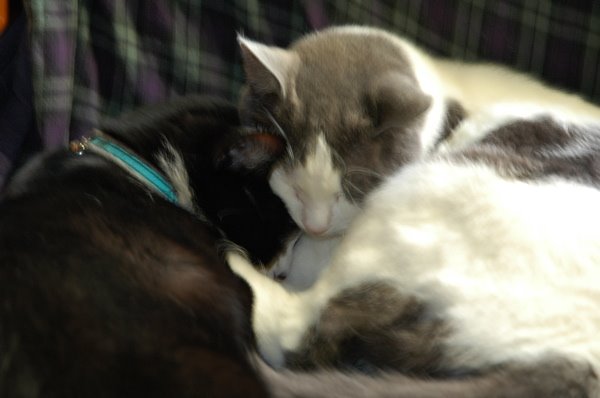
Well, another Friday rolls around and my blogging is seriously diminished right now. At least I have cats. I also captured an interesting person seated on a fire hydrant. It doesn't look comfortable.

Wednesday, October 11, 2006

Stiglitz vs. Phelps

I read this Q&A with J. Stiglitz and thought it a much more thoughtful and interesting read than Phelps, who happens to have won the Nobel Prize. This is normal, unfortunately.

Stiglitz:

Q. Since the beginning, economics has sought to perfect “economic well-being” as in, lay down the conditions to maximize well-being and explain faltering well-being. What does this well-being entail? There should be a definition of economic well being that functions independently of capitalist or socialist classifications. Would you care to explain your definition of the one entity that guides all economic theories: “economic well-being”?

Himanshu Kothari
United States

A. There is no simple measure of economic well-being, and unfortunately, the standard measure, gross domestic product per capita, is misleading. This is important, because what we measure affects what we do; and if we try to “maximize” the wrong thing, there can be serious adverse consequences.

I stress the importance of equitable and sustainable development and growth. GDP can be going up, yet most individuals can be worse off (as has been happening in the United States during the past 5 years).

Similarly, GDP can be going up, yet standards of living going down, as the environment becomes degraded, so much so that life expectancy can even decrease. When I was chairman of the Council of Economic Advisers, I pushed for the use of Green GDP, where account is taken both of the depletion of natural resources and the degradation of the environment.

If a country’s growth is based on depleting renewable natural resources, its growth will
Link not be sustained. Neither will growth be sustained if it is based on borrowing—when debt is used to finance consumption, not investment. Argentina’s growth in the early 90s was based on debt financed consumption, and selling off its national assets (often at unreasonably low prices). The inevitable day of reckoning came, and the country’s economy collapsed. Today, many are worried about America, whose growth is based on borrowing more than $3 billion a day from abroad.

GDP may be a misleading measure for another reason: it measures the value of what is produced in the country, not the income of the citizens of the country. When a developing country opens up a mine, with low royalties, most of the value of what is produced may accrue to the foreign owners; and when account is taken of the environmental degradation and resource depletion, the country may actually be worse off. [Keep reading...]

Phelps:

Dynamic Capitalism, by Edmund Phelps, Commentary, WSJ: There are two economic systems in the West. Several nations -- including the U.S., Canada and the U.K. -- have a private-ownership system marked by great openness to the implementation of new commercial ideas coming from entrepreneurs, and by a pluralism of views among the financiers who select the ideas to nurture by providing the capital and incentives necessary for their development. Although much innovation comes from established companies, ... much comes from start-ups, particularly the most novel innovations. This is free enterprise, a k a capitalism.

The other system -- in Western Continental Europe -- though also based on private ownership, has been modified by the introduction of institutions aimed at protecting the interests of "stakeholders" and "social partners." The system's institutions include big employer confederations, big unions and monopolistic banks. ... The system operates to discourage changes such as relocations and the entry of new firms, and its performance depends on established companies in cooperation with local and national banks. What it lacks in flexibility it tries to compensate for with technological sophistication. So different is this system that it has its own name: the "social market economy" in Germany, "social democracy" in France and "concertazione" in Italy. [hat tip to http://economistsview.typepad.com/] [Keep reading]

Phelps works his way through the usual clichés about U.S. vs. Europe. What is surprising is that it is so...unsurprising. Here is is brilliant conclusion:

Actual capitalism departs from well-functioning capitalism -- monopolies too big to break up, undetected cartels, regulatory failures and political corruption. Capitalism in its innovations plants the seeds of its own encrustation with entrenched power. These departures weigh heavily on the rewards earned, particularly the wages of the least advantaged, and give a bad name to capitalism. But I must insist: It would be a non sequitur to give up on private entrepreneurs and financiers as the wellspring of dynamism merely because [of the imperfections from these departures]. I conclude that capitalism is justified -- normally by the expectable benefits to the lowest-paid workers but, failing that, by the injustice of depriving entrepreneurial types (as well as other creative people) of opportunities for their self-expression
Capitalism is justified because otherwise entrepreneurial types would be creatively stifled. Ok. Deep. But he also says that capitalism plants the seeds of its own degredation. Really, what is one to conclude from this abstraction?

Friday, October 06, 2006

Friday, September 29, 2006

Friday Cat Blogging From the Left Paw Society

The Third Way is really just the second...

x-listed @ eurotrib.com

Almost simultaneously with the Philip Stephens article that Jérôme points out in his"Third Way" diary, the Post Autistic Economics Review comes out with an interesting article on that very subject:


Is New Labour's `Third Way' new or just hot air in old bottles
. The paper is interesting and downloadable to word for free.

Grazia letto-Gillies' article starts with a brief historical overview of the history of political economy in Britain since WWII: "The First Way refers to the period from after WWII to the mid 1970s; the second Way refers to the Conservative Government period starting from 1979; and the Third Way to the New Labour Government period since 1997."


She goes on to explain the dire economic situation of the 70s that led to Thatcher's 'second way', but she makes an important point: that the economic problems have turned out to be deeply embedded in the system itself:


However, in a way the major problem was for capital itself. Though some investment opportunities were created and some foreign capital attracted in more deprived areas, the basic problem was that the shedding of activities by the state does not automatically create profitable investment opportunities. Most of the activities which were in public ownership by the 1970s had originally become so because they were not profitable under private ownership. They did not necessarily or not always become profitable when the Thatcher government privatised them. With every privatisation the City went into euphoria because immediately after each selling by the government the value of the company shot up with huge gains for the buyers and for the institutions involved in the deals; this is not surprising given the fact that the public companies' assets were sold at grossly low prices. However, often the euphoria became short-lived as many companies faced difficulties and needed propping up with continuous handouts from the taxpayer


Thatcherism proved volatile, divisive and, in the end, unsuccessful and dissatisfactory. New Labour was thus elected with high hopes...


The expectations were soon to be checked by the reality of a government that: put economic prudence and stability over fulfilment of pent up needs; put the financial expectations and interests of the higher echelons of society, the City, the big corporations - domestic and foreign - and the right wing press before those of the millions of people who voted it in; proved to be very aggressive in foreign policy and over enthusiastic for wars to achieve those aggressive aims; developed a very cavalier attitude towards democracy and accountability on the strength of a high parliamentary majority achieved, partly, through the specific British electoral system


The author then goes into a lengthy discussion of New Labour's economic policies, especially healthcare. At every turn she notes the dissatisfaction (economic and affective) with the solutions. Again, the problems point to an overall weakening system rather than the ability or inability of governments to tweak elements of the system. The higher orders of global capital are to blame, that is to say, our beliefs in certain economic "laws" [I am perhaps reading into her argument here]:


The problems of this Blair-Brown grand design for the public sector are beginning to unravel and they will increase as time goes by: problems for the user of public services; problems for the health workers and eventually problems for capital; problems for the State and the political class. Why the latter two problems? Because this grand design signals a profound structural crisis for capitalism. If the system needs propping up via continuous State intervention it cannot be very healthy. So what is going to happen when all that can be outsourced is outsourced and an even larger share of inland revenue goes to pay for private companies' profits?


Moreover, the state is in danger of despoiling itself of major functions and this may lead to a problem of legitimacy: if the State's function is limited to collecting taxes and handing them over to private - domestic and foreign - companies for the actual provision of services can the State justify itself? Will this create also problems for democracy? (Florio, 2004: 155).


A separate important question may be one that political scientists and future historian of politics may be able to tackle: how is it possible for a Labour-led Parliament to preside over the erosion leading to the demise of the NHS and to similar trends in other public services? A question almost as important as why the parliament and the Labour Party did not call government to account over the Iraq war. The huge amount of obfuscating that has been and is going on may explain why it was difficult for the wider public to understand the significance of the changes, but not why competent elected MPs accepted them


In England, as here in America, the debate has been so constrained and so deliberately shaped, that it has become difficult to talk about--much less confront--the issues of capital. This reflects, in somewhat different terms, what Jérôme said earlier today about discourse:

So despite running a massive traditional left-wing tax-and-spend programme (while pretending to be neo-liberals), the Blair/Brown duo has stabilised inequality. Surely that would suggest that the focus be put on policies rather than on discourse?


If the left does not fight for the ideas of the left, nobody will bother to implement them. The right, pushed away from its natural right-of-center place in public discourse, will focus on populist or socially conservative ideas to try to regain ground, but will certainly not advertise the usual moderate socio-economic policies it used to practise while in government. Once in power, it won't feel the need to change the tone of economic discourse, but it is likely to stop the tax-and spend ways of government.


The problem is that all of our public servants believe the same thing; only their implementation vary, and only then by small degrees. We are lacking a philosophical tie to hold on to, to debate because our "leaders" are programmed, trained, sculpted by the same educational and formative experiences. We are highly in need of some true representation.

Thursday, September 28, 2006

More great news for children in the U.S.

The EPI is reporting that:


This is not surprising. However, every time I come across statistics like this, it reminds me of what a strange culture the U.S. has. Somehow, the words like "family values," "culture of life," and "moral compass" roll of people's tongues as if it were reality when in fact the reality is quite the opposite.

You know this, of course. Luckily, Medicaid steps in (minimally) to cover what the rest of our system does not.Image Source Courtesy of EPI

I can only think of Cat Stevens' "Where Do the Children Play?":

[...]Well youve cracked the sky, scrapers fill the air.
But will you keep on building higher
til theres no more room up there?
Will you make us laugh, will you make us cry?
Will you tell us when to live, will you tell us when to die?

I know weve come a long way,
Were changing day to day,
But tell me, where do the children play?

Saturday, September 23, 2006

Saturday Bird Blogging...

Here's a picture of a egret from Bolsa Chica. Lighting was not optimal, so it doesn't have

all the colors I'd like to see. Maybe next time.

I spent the morning thinking about torture. As usual, Digby gets this right--really, really, really, right.

Don't anybody say "I didn't see it coming."

Friday, September 22, 2006

Friday Cat Blogging from the Left Paw Society

Sorry to have taken so long to put this picture up. I've been busy torturing this cat for hours trying to get him to confess to eating my cheese. He kept denying it. Luckily, after several hours of dunking him in freezing water, threatening him with dobermans, and other "intensive techniques," he broke. He admitted not only that he ate the cheese, but that he was part of a conspiracy with the other three cats. Thankfully, now, my cheese is safer, and so is the world.For more expert information on torture, I recommend: www.whitehouse.gov

Tuesday, September 19, 2006

Cafferty puts Blacks in their place...

I hope everyone caught the Situation Room yesterday. Cafferty really let into Black people.

Let's go to New York, Jack Cafferty with the Cafferty File.

CAFFERTY: NAACP president Bruce Gordon says that despite his objections to the invasion of Iraq in 2003, he would listen to calls for help from Washington. The question we asked is how can African Americans help the United States end the war in Iraq?

Richard, "Blacks could confront the administration with the need to face reality and confront them and confront them and confront them. It may not make an impact on the Alice-In-Wonderland leaders of our government, but it would be nice to see some backbone, some consistent standing up to them, unlike most of our Congress.

Ger in Seaside, California, "They can't. This is our problem. I don't see how they can do anything but make it worse for themselves and I'm sure Black people will let their government know that they disprove of the idea." Paul writes, "Every warm body in the trench will help stabilize the situation. This is a good opportunity for George Bush to end the era of unilateralism and cowboy diplomacy. He should ask for and accept the assistance. Every non-U.S. soldier over there decreases the odds of our family members getting killed."

Eric in Chicago, "No thanks NAACP. We must look at this from their perspective. What's their incentive? Obviously it's more than just a peaceful world as they have passed on promoting peace on multiple occasions. Blacks being such a self-serving people, maybe we should dig a bit deeper before we decide to accept the offer."

James in Fresno writes my favorite, "What say we send a few busloads of Blacks to Baghdad? I can't think of a better way to help the Iraqis realize that there are indeed things less tolerable than the presence of American troops."

And John in Madison, Wisconsin, "It's about time. Blacks could teach al Qaeda how to surrender.:

If you didn't see your e-mail here you can go to CNN.com/CaffertyFile and read more of these online, Wolf.

BLITZER: See you in New York tomorrow, Jack. Thanks very much, Jack Cafferty. Let's find out what's coming up at the top of the top of the hour. Paula's standing by. Hi Paula.

PAULA ZAHN, CNN ANCHOR: Hi Wolf, Jack didn't enjoy those last two e-mails at all, did he?

BLITZER: No, not at all.

ZAHN: His laughter said it all. Thank you...


If Cafferty says it, it must be true, right? I mean he's a straight-shooter, an everyman, and an insightful journalist who can cut through the newspeak.

I should mention that I adapted the above transcript and replaced the word "France" with "NAACP" and French with "Black." Sorry, Jack, it was just so easy to do, sort of like your form of commentary.

Friday, September 15, 2006

Kids at work

Here is the church:(Federal Reserve)


Here was the steeple:


Open the doors, and here are the people (and here they remain):


SHEK YAN, China As workers poured out of factories into the evening sunlight, Samuel Wong trolled the streets of an industrial zone here in a minivan, looking for the garment factory he had come to spy on. In the jargon of the manufacturing business, Wong is known as a social compliance auditor. But sweatshop snoop might be a better description. Wong works for American and European companies that buy shoes, clothing and toys from Asian factories and that want an unvarnished view of what happens behind their heavily guarded gates - a job that the Chinese government, preoccupied with maintaining economic growth, has neither the will nor the resources to pursue.

Source: http://www.iht.com/articles/2006/09/15/business/inspect.php

Friday cat blogging from the Left Paw Society

Tuesday, September 12, 2006

My three-month fast is over...

In commemoration of 9.11, I haven't eaten or blogged for months. I have come to the conclusion that only extreme and visceral reactions to the event are worthwhile, while logic and measured action can only appease the terrorists.

It is now 9.12 and I can eat and blog again, but I will never forget the pain and suffering and fear I am supposed to feel to be a true American. 9.11 was a tragedy and we should keep it that way.

Thursday, August 03, 2006

Friday Cat Blogging from the Left Paw Society

Well, it's been a long year. My mother passed away two weeks ago after a long bout with cancer and blogging has been far from my priorities recently with family, work and other bits of life taking precedent over bloggerly matters.

I've been meaning to write about my mother, an amazingly talented person, and one of the purest good souls. I just don't feel like like writing it right now. Anyway, you know: I owe you much, mom, and so do many more whose lives you've touched. I leave it at that until I can find an elegant way to say it.

So, here is a shot of Biscuit looking at the moon.

Thursday, July 27, 2006

Monday, July 17, 2006

Wall Street Loves America

Well, actually, it doesn't. I can't blog much, but I had to put this in here for future reference:

http://bigpicture.typepad.com/comments/2006/07/post911_option_.html

Here's the story. I hope to be back to blogginsville soon.
The WSJ continues its recent habit of burying killer stories in the under read Saturday edition. This week's bombshell has to do with post 9/11 earnings grants:

"On Sept. 21, 2001, rescuers dug through the smoldering remains of the World Trade Center. Across town, families buried two firefighters found a week earlier. At Fort Drum, on the edge of New York's Adirondacks, soldiers readied for deployment halfway across the world.

Boards of directors of scores of American companies were also busy that day. They handed out millions of bargain-priced stock options to their top executives.

The terrorist attack shut the U.S. stock market for days. When it reopened Sept. 17, stocks skidded more than 14% over five days, in the worst full week for the Dow Jones Industrial Average since Germany invaded France in May 1940. But for recipients of options, the lower their company's stock price when options are awarded the better, since the options grant a right to buy shares at that price for years to come. The grants set recipients up for millions of dollars in profit if the shares recovered.

A Wall Street Journal analysis shows how some companies rushed, amid the post-9/11 stock-market decline, to give executives especially valuable options. A review of Standard & Poor's ExecuComp data for 1,800 leading companies indicates that from Sept. 17, 2001, through the end of the month, 511 top executives at 186 of these companies got stock-option grants. The number who received grants was 2.6 times as many as in the same stretch of September in 2000, and more than twice as many as in the like period in any other year between 1999 and 2003.

Ninety-one companies that didn't regularly grant stock options in September did so in the first two weeks of trading after the terror attack. Their grants were concentrated around Sept. 21, when the market reached its post-attack low. They were worth about $325 million when granted, based on a standard method of valuing stock options."

What makes this so pathetic is that corporate executives could have stepped up AND BOUGHT STOCKS IN THE OPEN MARKET if they believed they were so cheap. It would have been reassuring to a nation to see the leaders of industry voting with their own dollars. It might have made the subsequent economic slow down and period of tense aftermath less painful.>

Instead, these weasels decided to loot the treasury at the first opportunity. America was smouldering, the WTC lay in ruins, and this group of classless pigs decided it was time to pocket some cash.

I'm going to take it a step further: These assclown executives are unAmerican. They are not Patriots, they are not model citizens -- they are merely a pathetic group of opportunistic whores who might as well hang outside the Holland Tunnel looking for a quick buck (although that would involve risk and work, something they have shown a distinct aversion to).

In 1929, when the stock market crashed, JP Morgan (and others) stepped in. They bought stock with their own dollars, they saved Wall Street. Oh, and they were rewarded for it -- both monetarily, and in the history books.

What the more recent group of execs did is probably legal. It certainly isn't ethical, and it reveals them to be "lacking in moral turpitude rectitude." I wonder if there's a morals clause in any of their employment contracts.

What a pathetic group of weasels. Brain cancer is too good for these shitheads. They -- and their lapdog Boards of Directors -- should all be fired.

Friday, June 30, 2006

Friday Night Ladybug Blogging


We took a hike up Icehouse Canyon last week. It was hot, humid and the bugs were hungry. It was also ladybug mating season. By the time I could get a few shots, I was covered in them. I like ladybugs, but, well, that's about as far as it goes. No great pictures, but it made for some fun photoshopping as in the second picture.

Friday Cat Blogging from the Left Paw Society

Thursday, June 29, 2006

Geoportail / Geoportal

The French government just rolled out it's new geo-portal similar to Google Earth. The servers are getting hit hard right now, so I can't comment on the service yet, but I'm going to go ahead and link to it. (IGN, je t'aime moi non plus.)

Le voilà: http://www.geoportail.fr/index.php?event=DisplayAccueilVisu

And my predictions...

France 2-Brésil 1

Tuesday, June 27, 2006

Resource Nationalism

The Financial Times reports today on a document received from the U.S. Military:

Future supplies of oil from Latin America are at risk because of the spread of resource nationalism, a study by the US military that reflects growing concerns in the US administration over energy security has found.

An internal report prepared by the US military’s Southern Command and obtained by the Financial Times follows a recent US congressional investigation that warned of the US’s vulnerability to Venezuelan President Hugo Chávez’s repeated threats to “cut off” oil shipments to the US.

The report itself notes that "A re-emergence of state control in the energy sector will likely increase inefficiencies and, beyond an increase in short-term profits, will hamper efforts to increase long-term supplies and production..."

Ah, those darn increased inefficiencies. I'm assuming this means that Venezuela is increasing its taxes from next to nothing to twice next to nothing. I'm assuming that democratic politics which place local needs above those of Barbies and Commando-Wannabes tooling around in SUVs is also an inefficiency.

Question to readers: Has anybody been to the Moonie Ranch in Paraguay? 1.5 Million acres. Maybe Neil Bush is there working on his lobbying skills.

Monday, June 26, 2006

Racism

The Economist has its new edition out with this on the cover:


As Jérôme à Paris says, "...now that they are giving it the legitimacy of their front page, with the usual French bashing (calling the young rioters of last November "Muslims" is simply plain false, and the image of the Eiffel tower is anything but subtle), expect more hand-wringing about Europe's seeming unability to deal with its own problems"

Indeed, the article is full of what can only be called propaganda. To starting with, as Jérôme notes, the not so subtle cover. What exactly are they trying to imply? Is France too Muslim? Are the Muslims taking over?

The article has a telling graphic:
(thanks to eurotrib.com for the image)

Really, now, "Where they are"! That's right. You can't be European and Muslim. I'm glad that's all cleared up.

Thursday, June 22, 2006

Yes, Master. Yes.

As you've probably noticed during your daily scroll through the headlines, the House failed to renew the Voting Rights Act yesterday because a few Republicans objected to the act's "singling out" Southern states who have a history of racism. No doubt, these Republicans feel the South does not have a history of racism but rather a heritage:
"The amendment's backers say the requirement unfairly singles out and holds accountable nine states that practiced racist voting policies decades ago, based on 1964 voter turnout data: Alabama, Alaska, Arizona, Georgia, Louisiana, Mississippi, South Carolina, Texas and Virginia." [Source]
A Republican, either oblivious or opposed to history added,
"I don't think we have racial bias in Texas anymore." [Rep. John Carter, R-Round Rock.]
That's right. It's the "End of History." Those things aren't happening anymore.

Well, actually, they are. Take for example Georgia's on-going push to get a voter ID for which the courts handslapped them last year (from the WaPo: "Voter ID law overturned, Georgia can no longer charge for access to Nov. 8 election..."). Everyone knows about the inaccurate list of "felons" that prevented many people without any previous convictions from voting in 2000. Similarly, in 2004, the RNC came up with a brilliant plan to keep African American votes from counting in the last election. Greg Palast explains:

"Here’s how the scheme worked: The RNC mailed these voters letters in envelopes marked, “Do not forward”, to be returned to the sender. These letters were mailed to servicemen and women, some stationed overseas, to their US home addresses. The letters then returned to the Bush-Cheney campaign as “undeliverable.”

The lists of soldiers of “undeliverable” letters were transmitted from state headquarters, in this case Florida, to the RNC in Washington. The party could then challenge the voters’ registration and thereby prevent their absentee ballots being counted." [Source]

And, of course, I'm not even going into Ohio.

This should be our national shame. We should be outraged. Yet the VRA, like affirmative action, like good public schools, like tax breaks for the wealthy--like so many things--is one of America's many blind spots to its own racial and classist history. Here's a picture I took at the Atlanta airport a few weeks ago (yes, June 2006). What do you think?


Is it racist? Think it's funny? I think it is sad, and, well, it pretty much sums up where we are to me: we have this system, it's racist, yet we stare at it with a sense of irony which allow us to process it and move on. That's too bad, because it goes much deeper than all of this, back to the core of our "national character." And this brings me to something Digby wrote (and I responded to) a few months ago.

Digby
We seem to have a little glitch in our national psyche that won't go away. It isn't just southern anymore. The misadventure of the last five years has been run by a southern dominant political party, but its architects were elite, cosmopolitan intellectuals. This is an American problem and we are going to have to get rid of it if this country is going to survive.

I responded to Digby's post this way:

I couldn't agree more. We are still paying the price for the Missouri Compromise and for the failed Reconstruction period after the Civil War. This is true for race relations, as Katrina and its aftermath amply prove, and, just as importantly, it is true for class relations.

I am not a Civil War historian, but I am from the South and lived in the South for a long time before coming to L.A. One thing I know about red states is that they are a model of colonialism and extraction, seeking to suck out the fruits of natural resources and human labor where they can.

If the most efficient means of labor/resource extraction means classifying a group of people as sub-human, then that is the obvious path. If that becomes socially or politically unacceptable, then other means become necessary. The South's loss in the civil war was as much a social conversion as it was a resource failure. In fact, it is a myth to think that the South lost because it did not have industry. The South lost because people gave up. If the average Southerner in 1864 really believed in slavery and that the slave-owner society was really helping the average citizen, then the South, in 1866 or 1867, would have resembled Iraq in 2006--there would have been widespread rebellion, uprising, guerilla war. This did not happen. Why? The answer if of course complicated, but, in part, it is because many, many white people were oppressed by the upper-class land owners. These whites, while having many more benefits than slaves, obviously, understood that the system was working against them. It was not their war to begin with. How else does one explain the huge desertion rates in the Southern army? (I know, I'm generalizing.)

To get back to my point, and perhaps yours, something changed during reconstruction. As soon as Blacks had "equal" status, they could become the boogeyman for Whites. White Elites exploited this to their full advantage and began to mythologize racism and the "Golden Age of the Old South" through groups such as the KKK --and the Southern Democrats.

The racist mythology allowed poor Whites and rich Whites to find a common ground at the beginning of the 20th century, and at the present. The Republican party, as everyone knows, constantly summons this racist mythology through hint and allusion by nominating racist judges on MLK's birthday, by avoiding speaking to the NAACP, through talk radio and TV pundits. And this is where it gets dangerous, as D. Dneiwert, among others in the blogosphere, points out. The racist myth is so pervasive, so easy to tap into, and so powerful (because its fallacies seem to explain so many things), that a word here, an image there, and our Mass Media has fed into and propagated a racist creed. It is a creed that is false, but powerful because it imbues the believer with power, with an impression of superiority, and this "superiority" crosses class lines, and that is the ultimate scam.

So it isn't just Southern (it never was, it was just more so), and it isn't just race. I have lived abroad, and I will say that America is one of the most racist places I know. Racsim is a huge, huge problem. That said, I feel that it is the ability of the myth, through racism, to elide over class issues that is causing us problems today. It isn't that the "South" has taken over; it is that the extractors, those adept at mining the land and its humans, have come into power. Their belief system in 1860, like now, was exploitation (of blacks and whites), elitism, and expansion. The extractors, now as then, are constantly seeking new territories and peoples at the lowest cost. It is their way of hiding the true cost of their (and our) wealth.

They know that the weath of the here and now almost always comes at the price of people and land. They just don't care.

Look at how the Republican leadership frolics in New York and L.A., supposedly speaking for the "common man", while, in reality, the red-states they represent are among the poorest regions of the country. Though to a lesser degree, Kansas and South Dakota are to America what Africa and South America are to the "developed" world.

This is the Brand America they have created; its purveyors are Fox News and Malkin and Bush. They are all racists, they are all elitists, and they just don't care. The only hope is not it some PC version of eliminating racism, but in re-forming the instutions that purvey the racism and exploitation of Americans, namely government, big business and the media.

Whoever the next president may be, the only real hope is in "demolishing" large swaths of the federal government, and by that, I don't mean getting rid of it, but re-doing it. The Republican party has infiltrated every nook and cranny of government and will hold on to those positions no matter what. The only way to get rid of them is to litterally re-invent the departments from the ground up, removing, where possible, the revolving doors, promoting career officers, etc. Re-organize is perhaps the best term, but there will need to be some creative destruction before the demons of the Republican party, which are overwhelmingly the demons of the Civil War and the Reconstruction, are sufficiently reduced, removed, or whatever.

I do not want to absolve the Democrats in this. They carry a huge blame historically in promoting racsim and exploitation, but, presently, they are simply a weak, rudderless party. The Republicans are, and they know it, up to something far more dangerous and corrupt. It will take an earnest Reconstruction of government to repair what the Republicans have done and continue to do and to make progress in alleviating the burdens of our national demons.
So ended my diatribe and I apologize for quoting myself at such length, but, until there is some sort of reconstruction of government and the social order so as to actually understand and create solidarity with people rather than the interchangeable poles of disdain and pity, then we should be taking note. The VRA is about understanding that voting is not as easy for some as it is for others. Yet even the Voting Rights Act is only a palliative, an advil offered in lieu of real medical intervention: Heck, in most countries people vote on a Saturday or a Sunday, or they make it a national holiday. Now that would be fair to working people of every race and class. That would be an attempt to put all citizens on a more equal footing.

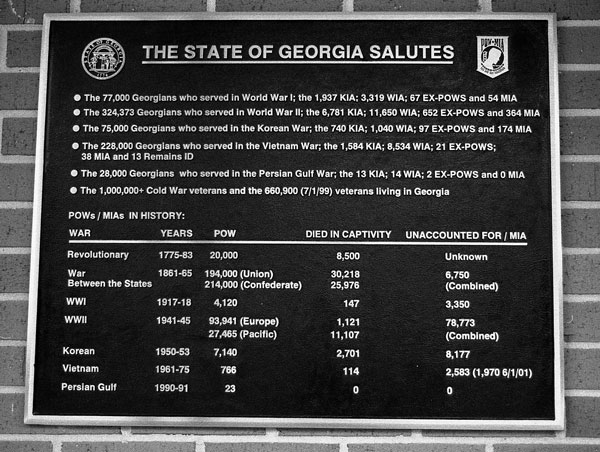
For good and bad (mostly bad), part of the American dream is a dream of isolation. Isolation from religious persecution, isolation in our cars, isolation in our suburbs. Part of us has thrived on being separate and our economy has grown out of this, our physical and social space has grown out of this. We're partially blind to it, and, yes, Southerners can be even more blind, as the above picture shows. And if Southerners are not somewhat blinded by their own history, why do they continue to portray themselves (oops--ourselves--I am from Georgia) as heroes rather than insurrectionists? Take a look at this tribute to American Insurgents below:

I suppose it is OK to dedicate a plaque to the POW of the Civil War, but perhaps they should mention all those other millions of prisoners that tilled the fields, picked the cotten, ironed the clothes, washed the dishes, and got whipped because they said they thought they were as good as Whites.


So it is racist to say "Blacks" are inferior or "Mexicans are inferior." And it is just as racist to say that racism is over and done with because it purposefully removes the debate about race and class in the U.S. Until there are no more memorials like this then I will assume that the South still has a few "issues."

Friday, June 16, 2006

Friday cat blogging from the LPS


Marathon and Biscuit, the latter was shot on some old Polaroid 3000ISO film I have lying around. Hard to use that stuff except for some very specific purposes, but I thought I'd give it a try here even though it's no match for slower films.


Friday, June 09, 2006

Friday, June 02, 2006

Saturday, May 27, 2006

On silent thought

Great little editorial here by Ignacio Ramonet on the role of intellectuals. He mentions, in passing, that Bernard Henri-Levy is "indulg[ing] in exhibitionist self-destructiveness." Yeah, no kidding. The man who is often quoted as France's most important philosopher (and who is therefore understood to be a "French Leftist"), actually writes for a conservative magazine and is often nothing more than an apologist for conservative ideology. Also, his road trip last year, meant to cast him as some kind of new de Toqueville, produced one of the most boring series of articles I've recently read. (It was in the Atlantic Monthly, another stealth conservative magazine, IMHO).

Like so many on the right, BHL fights so hard to un-explain (philosophically distort) the obvious truth that his writing becomes tedious. As Lloyd Benson would say, I knew de Toqueville, and BHL, you're no de Toqueville. Anway, read Ramonet's little piece on public intellectuals and you'll see why we are where we are.

Silent thought

By Ignacio Ramonet

Once again, during the recent revolt against the First Employment Contract, the enthusiasm and dynamism evident on French streets were in marked contrast with the disconcerting silence of French thinkers and writers. The same was true during the November riots in the banlieues. There was a lot of chattering, but few, other than such rare figures as Jean Baudrillard and John Berger, were able to read the events, uncover their deeper significance and suggest what they might portend. With no relevant or encouraging diagnosis forthcoming, society was left in the dark about its symptoms and in danger of succumbing to further crises.

In France an intellectuel is defined as someone who uses a reputation in science, the arts or culture to mobilise public opinion in support of causes that he or she regards as just. In modern states, it has been the role of the intellectual for two centuries to make sense of social trends, illuminating the path towards greater liberty and less alienation.

What the recent crises have demonstrated is how much we miss the analytical intelligence of Pierre Bourdieu, Cornelius Castoriadis and Jacques Derrida, to name three great thinkers no longer with us. A sense of loss has inspired us to examine the current war of ideas. Are there any real thinkers left, or has the media explosion shattered their authority? Why (as if the hatred of fascists and the aversion of the American right were not enough) do such writers as Bernard-Henri Lévy indulge in exhibitionist self-destructiveness? There is a central issue here - the way in which, in publishing and the universities, private interests are enlisting prestigious thinkers as allies in an ideological struggle.

Here are a few thoughts on the subject from some major thinkers in the past. First, Michel Foucault (1): “For a long time, ‘leftwing’ intellectuals spoke out as masters of truth and justice . . . They were heard, or claimed the right to be heard, as representatives of the universal. To be an intellectual was to be, to a degree, the conscience of all. But it is many years since intellectuals were called upon to fulfil this role. Intellectuals became used to operating, not within the universal, the exemplary, the just-and-true-for-all, but in given sectors, in the specific contexts where their own working or living conditions situated them . . . Working in such situations undoubtedly gave them a far more concrete and immediate awareness of struggle. And there they encountered problems that were specific, not universal, and often different from those of the proletariat. I would argue that this brought them closer to the masses, since these were real, material, everyday struggles in the course of which they often encountered, albeit in a different form, the same enemy (the multinationals, the police and legal machines, property speculation) as the urban and rural proletariat. That is what I mean by ‘specific’, as opposed to the ‘universal’, intellectual.”

Then there is Gilles Deleuze on what to do with ideas (2): “A theory is exactly like a toolbox. It must serve some purpose. It must work, and not just for its own sake. If there is no one to use it, starting with the theorist, who thus becomes a practitioner, it is either worthless or its time has not yet come. You do not go back to a theory, you make others and there are always more to be made.”

Pierre Bourdieu (3) proposes a new and radical thinktank: “Many historians have highlighted the role played by thinktanks in the production and imposition of the neoliberal ideology that now rules the world. To counter the work of these expert groups, appointed by our rulers, we need the help of critical networks . . . They should form autonomous intellectual collectives, capable of defining their own objectives and the limits to their agenda and action.

“Groups should start with negative criticism, producing and disseminating tools to defend us against symbolic domination, increasingly backed by the authority of science. Drawing on the strength afforded by their collective skills and authority, such groups can subject the dominant message to logical criticism, targeting its vocabulary, also its arguments. They may subject it to sociological criticism by highlighting the factors influencing the people who produce the dominant message, starting with journalists. They may counter the supposedly scientific claims of experts, particularly in the field of economics.

“The whole structure of critical thought for political purposes needs rebuilding. This cannot be the work of just one great thinker, locked in solitary thought, or the appointed spokesperson of some body, speaking on behalf of all those deprived of the means to speak. On the contrary, intellectual collectives can play an essential role, helping to lay the foundations in society for the collective production of realistic utopias.”

Right: reality-based utopias (i.e., hope and striving for a better future, not some crazy-scheme like gated communities, Disneyland, or Celebration Florida).

I have to say, though, that I've read all of these folks, and, frankly, I also find them tedious (but undeniably pithy). For our think-tanks to work, we have to get back to simpler language and direct engagement rather than engagement filtered through theory. Simple does not mean simplistic. When theorists opt for too much academic language, they opt for disengagement--hence my problems with much of this. Baudrillard, for one, took off his academic masks after 9/11 and wrote some of his most probing works, which also happened to be a culmination of his cultural intuitions of the last 40 years.

We do not need the supposed "authority" of obscure language to inform a progressive future; reality itself provides us with plenty of examples of the failures of the right (and left) to allow us to move ahead. Public polls on heath-care, on clean air and water are the models for this.

Friday, May 26, 2006

Friday Cat Blogging from the Left Paw Society


Staring at a puddle, or the sky in the puddle, or something. Besides the NSA, of course, who really knows what cats think?

Tuesday, May 23, 2006

Independent Women

As I was perusing Wikipedia last night, I came upon Norman Podhoretz's wife's name, Midge Decter. It turns out that Decter created something called the Independent Women's Forum. I was curious and scooted over to their site. It didn't take long to see that the IWF seems more about Right-Wing propaganda than helping women. A quick look at the blog and you know you're in Michelle Malkin territory:

Some choice quotes from the blog

On Human Rights:
Aren’t you sick of all the propaganda about awful it is for the "tortured" Al Qaeda and Taliban suspects detained down at the U.S. Naval base at Guananamo Bay?

On Iraq:
Michael Barone blows the lid off a story that the mainstream media is covering up:

“Things are better than you think. Yes, I know, most Americans are in a sour mood these days, convinced that the struggle in Iraq is an endless cycle of bloodshed, certain that our economy is in dismal shape, lamenting that the nation and the world are off on the wrong track. That’s what polls tell us. But if we look at some other numbers, we’ll find that we are living not in the worst of times but in something much closer to the best. What do I mean?”

On Grief:
Another tragic automobile accident claimed the lives of two promising high-school girls over the weekend. Quite predictably, grief counselors are descending vulture-like on their school this morning.

It’s a safe bet than none of the youths will be told to suck it up and be dignified.


Ok, you get the drift: things are GREAT in Iraq; torture is good; counselors undermine the American culture of "personal responsibility." They sound like one of those outfits that the Bush administration could get along with...Hey, wait a minute! Look what I found: The IWF was given a grant to "to focus on the immediate promotion of women’s full political and economic participation in Iraq."

Obviously, the IWF is a culturally sensitive organization that is uniquely qualified to bring their brand of "feminism" to Iraq and I'm sure that they got their grant fair and square. No matter that Lynn Cheney, Midge Decter, Kate O'Beirne are among its former directors.

Yes, they got their grant because
IWF is the essential, informed, articulate voice of thoughtful and caring mainstream women in the policy and media battles that shape our nation's future. While showing that we have both a head and heart, we promote voluntary, cooperative approaches to life's challenges that can brighten the future.


I love these people.

"William! William! Get your hands...

off my cash!" Tom cried.

"You'll have to pry it from my cold, dead fingers, Delay. This money's mine and I'm going to put it, uh, in my freezer," William shouted back, never once diverting his gaze from the former exterminator's black, devious eyes.

But William Jefferson felt a pang of fear run down his spine. Delay was "The Man." He ran The System. He knew how to cause pain, how to get Homeland Security on your ass, how to humiliate you, how to put you on life support and piously, mockingly pray for you on TV. Delay was a monster and a machine.

Finally, swallowing hard and hoping that Delay hadn't noticed the expression of doubt that had crept across his face, William spoke again:

"No way, man. I'm not giving you a dime. You never let me in on your game, why should I give you a cut? No. No fucking way. Look at you. Your wife, your kid--they've earned 500K just from working for your PACs. You can walk into Citronelle, smoking a Cuban, and a free table just appears. You see, I don't have friends named Bush, Cheney, Abramoff, Scanlon, Ralph Reed or Terry Schiavo--I'm just one man."

Delay looked down at the William's briefcase. His nostrils flared as the scent of money filled the room, then a look of calm came over the man from Sugarland's pock-marked countenance as he spoke:

"That's right, William. You're just one man, and that's why you'll go down in flames. That's the number one rule of America: failure, like success, is only individual. Do you think the news programs are going to take the time to explain a system? Does anybody remember the Keating Five and John McCain? How about Neil Bush and the S&L scandal? Nope. Question the individual, not the racket... "

"Sir!" an aide said, busting in, "there's a vote in five minutes."

Delay turned around and headed out the door. Pausing a moment, he turned to William and said:

"Too bad, William, you could have been a Republican."

Little did he know, but Delay was right. You never question the system and you never operate outside of it. Furthermore, you never--never--go into public life with any combination of the names "William" and "Jefferson."
****


Excerpts from "Conversations Overheard in a Capitol Hill Restroom."

Saturday, May 13, 2006

Police State Porn

The NSA story seems like old news now, having come out last week, but I can't seem to get it off my mind. For a while, I was merely indignant, but then I realized that this latest revelation was echoing in my mind because it was also a reverberation of so many other moments in this administration's history. The story also reminded me of the state of our country, not only politically, but also socially. What kind of community allows this to happen? I am not--I don't think--a naive fool who thinks we should be one happy family, but I do believe that our nation has the possibility of better communicating a few national aspirations to each other and perhaps even fulfilling them.

Currently, we Americans have the illusion that watching our neighbors is the same thing as living with and taking care of them. We seem to think that keeping an eye on each other leads to protection, that surveillance is the same as guardianship, that knowing ourselves through voyeurism can somehow replace real community. This is tragic--but not necessarily inevitable as some historians would have us believe.

A real community watches out for itself, but it does not cast narcisisstic, domineering glares. Its members know each other and not merely of them. A community has institutions that reflect it such as health care and schools and libraries. Of course, not only do Americans often lack this sense of civic community, the Bush administration is actively undermining our ability to create such a thing. And that is perverse.

The current administration's obsession with controlling, gathering (and possibly abusing) surveillance is nothing more than a form of voyeuristic pornography for an elite for whom even the illusion of domination, of total information (and sensory) knowledge brings pleasure--and certainly gathering it all, all the information, all the records brings merely over-stimulation, not true understanding, interaction or follow-through. And perhaps follow-through and arrests are not really the intent.

Indeed, today on CNN when Bill Frist refused to say (citing secrecy) whether the NSA's culling had delivered even a single arrest, it is highly likely that he didn't name an arrest because there haven't been many, if any at all. In fact, the program probably does not deter terrorism or catch terrorists. But this lack of anti-crime effectiveness in no way diminishes the effect such a program has on the American psyche as an intimidating information-gathering practice. Nor does it diminish the feeling of power it confers upon those who control it. And that is why I call it pornographic and voyeuristic, because consummation (in this case, criminal convictions) need only be a distant dream as long as the power feeds those who find use in this technology. Our leaders seem addicted to this feeling and, for them, dealing with the FISA court is like looking the adult store clerk in the eye. It diminishes power. It ruins the effect.

Of course, all of this parallels (in form and sometimes function) the "legalization" of torture, the previous NSA wiretapping revelations, the perverse use of language in things like the Clear Skies Act (Initiative?) and Operation Iraqi Liberation (OIL), the strangeness (cruelty) of appointing a racist judge on MLK's birthday, and the countless acts of disrespect and imposed indignity documented over Bush's already interminably long tenure in the White House. As Lambert at Corrente noted (according to FDL), Bush explained the NSA program right in front of a large graphic detailing the NSA's "choke points" where they do their information gleaning. That is called rubbing your nose in it. It is a form of humiliation that brings pleasure to some.

So forget for a moment, if you will, that we have laws in the form of a constitution. Forget that we have a congress. Forget that we have a FISA court. Instead, think of community and all of the above as iterations of a form of community that protects itself from outside threats, from inside threats, and all the while protects the weakest members within that community from its predators. It is from that sense of community that the laws, the constitution and the courts originally arose. Now, regardless of their implementations and interpretations through history, we should strive for that sense of natural law and common good. And that is why the predation and voyeurism are dangerous: they are not merely prone to abuse, they abuse, demean, demoralize and eventually weaken the very community they supposedly serve.

So when the cries of incompetence, stupidity, hubris and greed are more or less forgotten, one defining description of the the GW Bush presidency will remain, must remain: that of the predator, of overwhelming and inexorable predation that gets off on power, that gets off on peeking, prying and on the effect such acts have. Predation of labor. Predation of markets. Predation of public lands. Predation of foreign lands. Predation of public discourse. Predation of our "unalienable" rights to privacy in our bodies, our homes and in our communities. We have been violated.

Friday, May 12, 2006

Sorry

for lack of posts. I hope to find a minute in the next few days.

Wednesday, May 03, 2006

Illogical and Inane at "The Nation"

This week The Nation has a particularly inane article (behind its firewall) that simultaneously channels Joe Klein and the DLC. In "Help Wanted: GOP Managers (With Pay Scales Soaring, Only Bumblers Are Willing to Work for the Government," Thomas Geoghegan succeeds at what so many Washington pundits are good at: speaking from a purportedly Democratic point of view while consistently undermining Democratic and democratic ideals. To say that Geoghegan's article is silly is to give it too much credit. Moreover that implies that the progressive left should laugh it off. We shouldn't, and here's why.

The article starts off by making a few correct points:
It seems that the Republican Party, the business party, the party of management, has a lot of difficulty managing. Our government cannot execute the basic plays. Let's look past Katrina, and FEMA, and Michael Brown. Let's look past the mismanagement of the oil and gas leases out West, the FDA's bungling over Guidant and its appointment (subsequently retracted) of a veterinarian to head the Office of Women's Health. Let's just consider the new Medicare drug program. The Bush Administration can't even perform a simple thing like getting people off the state Medicaid computer list and onto the Medicare computer list. In 2004 there was a serious shortage of flu vaccine. John Kerry failed to make an issue of it, but the voters should have been alarmed. It was an omen of the bungling to come in New Orleans. This is a government that cannot do even simple things.
Ok. Clear enough. But, starting with his second paragraph, Geoghegan goes seriously astray: "It appears that the Republicans when in power have no good managers. In an economy of superstars who make millions, the GOP can't afford to hire them, especially the ones who are indifferent to public service and gravitate to the Republicans in the first place--or to no party at all." [Emphasis mine]

Let's put aside for a moment some of Geoghegan's assumptions that business superstars are necessarily better managers than promotions from the ranks; that anyone making less than a "superstar" salary must be less competent; that someone who is indifferent to public service is going to enter government (at any salary) and act in its (and the people's) best interest.

Geoghegan goes on to write:

What may be more crippling to Bush's efforts to recruit people is not the CEO pay but the pay of the vice presidents just below them. That's where the government might look for talent to manage at the assistant secretary level. But it is questionable how many of these managers can afford public service--for a year perhaps, but not for three or four, much less two presidential terms. A friend of mine in a top-rank job at a huge global firm told me of a colleague of his in a rising American company. The colleague was now head of personnel, or human relations. "And do you know what his salary is?" my friend told me. "It's $5 million a year." Five million dollars a year--for a personnel director. It is unlikely this man is going to go home and tell his wife, "I'm ready to work for $120,000 a year because I want to help George Bush reogranize the Census Bureau."

[snip]

Now what's most distinctive about Bush is that he's floundering to find managers.

[snip]

There should be some sympathy for George Bush's attempts to persuade a talented human relations manager to give up $5 million a year to take a job writing regulations for the Federal Register. It seems unfair to question the patriotism of such people...It's hard to take in the scale of sacrifice.


You know, I do question the patriotism of anyone who puts money above public service. Sacrifice? How is that people who preach all day about the sacrifices of soldiers can't subsist on over 100K per year? But let's assume government jobs are too big of a "sacrifice" for people on Wall Street and K street. Are there any real Americans left to do the job?

Well, millions of firefighters, school teachers, soldiers and others live happy lives in this country without being solely motivated by money. Perhaps they couldn't manage FEMA, you say. Fine. Yet there are governors and state-level managers around the country who have spent their lives in dedicated public service who could easily manage FEMA, Census or any other government branch. Even George Bush hired a competent, rich Secretary of Treasury, Paul O'Neill. O'Neill did a good job, he was honest, reliable, concerned--and therefore he was forced to retire. And therein lies the problem with Geoghegan's assumptions about our president. Is it not possible that what normal citizens see as mismanagement (by Brown, by Chertoff, by Rumsfeld) is actually precisely the result that George Bush and corrupt Republicans want? Is is not possible that many right-wing people want to manage government towards implosion and failure because their goal is to eliminate or severely reduce public programs like Social Security, Medicare, FEMA, HUD, or HHS? I would argue that Republican rhetoric of the last twenty years has embraced the anti-democratic and oftentimes racist values of those who opposed FDR and of the John Birsh Society. I would argue that structural failure at, say, FEMA, is actually considered a sucess by some people like Grover Norquist, who wish strangle government until it dies. I would argue that George Bush agrees with Grover Norquist, as his tax program proves, and that George Bush is doing his part to hasten the collapse of the Great Society and the New Deal. Given this, no one should have sympathy for George Bush.

We should fear our president for his ability to do harm, and we should fear his pseudo-critics (who are actually apologists) like Geoghegan, who fail to understand the connections between our government's failures and the underlying "conservative" philosophy that seeks their doom.

Furthermore, pointing out the exorbitant salaries of corporate America does little to convince me that paying government managers more is necessary, nor does it convince me that "only bumblers" are willing to work for government. Perhaps I am one of those "Liberals [who] tend to sneer about the revolving door and how so many in the GOP cash in on public service via lobbying on K street." Well, since all that GOP cashing in is proving to be highly felonious, well, allow me a sneer or two. Also allow me to believe that K street is not good for America regardless of its reality.

Geoghegan doesn't convince me either that our government is naturally full of "bumblers" and that we need corporate assistance. Is Geohegan saying that Richard Clarke is a bumbler? Are all of our generals? The FAA? The National Park Service? These agencies have, without a doubt, numerous mid- to upper-level managers more than capable and more than willing to the job. Likewise, there is more than ample evidence that Bush and the Repbulicans want to gut government programs. In other words, Bush did not promote internally because, as I said, he has neither the American people's nor its government's interest in mind.

Bush does not deserve our sympathy, he deserves our scorn--as do Geoghegan and the Nation's editors for publishing this article that sounds like it emanated from the fingers of Joe Klein. Really. There are more problems with Geoghegan's argument that I won't go into, and this article should have been sent back as a first draft with the words "Rewrite after checking with reality and an exorcist specializing in DLC possessions" written on the first page. With so many good journalists like Jeremy Scahill and Naomi Klein to call, The Nation could have filled these pages with an opionion worthy of its reader's time. They didn't and in so doing they hurt the Democratic and democratic causes they normally serve.


Monday, May 01, 2006

It's Mayday...

Today should be the day when all but the most essential workers in the U.S. get the day off. Alas, today is Law Day. And, you know, sometimes symbolism is important, and today should be a symbolic day. It is a date that commemorates the weekend, the 8-hour workday, child-labor laws, etc. Instead, our governmen t calls it Law Day, as if worker activism and the law were contradictory. I wonder how many high-school teachers are using today as a teaching moment about anti-labor forces in the U.S.? I wonder how many of them feel comfortable doing so?

Sunday, April 30, 2006

Full Metal Pinochet

Driftglass says it like it is:

These are the fuckers who learned at the feet of Nixon. And who believe that the mistakes Nixon made had nothing whatsoever to do with him trying to do a sweep-and-clear of the Constitution with a flamethrower.

According to their Milhousology, the only errors Tricky Dick ever made were tactical. That in the end he didn’t have the nerve to do what needed to be done: burn the tapes, chuck a few dozen journalists and liberals into federal graybar – maybe have one or two executed for ginned war crimes to tune up the rest -- and roll a few tanks in the streets if necessary.

That he pussed out when he should have gone Full Metal Pinochet.

Friday, April 28, 2006

Friday Cat Blogging from the Left Paw Society

All-time-stupid web-feature award (a rant)

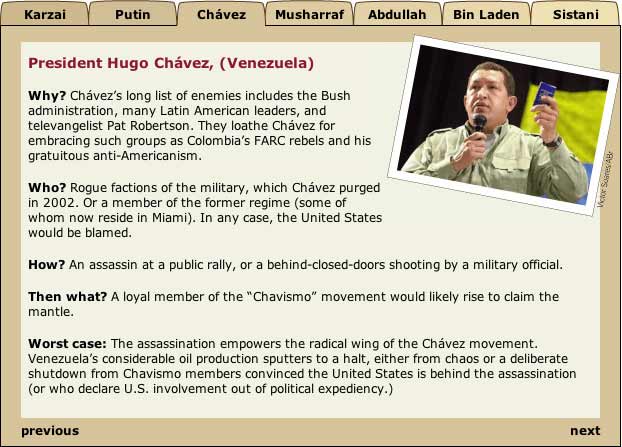
Is it "Foreign policy for idiots" or "Foreign Policy: For Idiots"? Take a look at this "web feature" over at Foreign Policy and see what you think?They even tell us how! Wow! I'm floored! What insights! What depth! (No more !'s, sorry.)

I've always known that FP wasn't the world's most serious "serious" magazine, but this? Just when I begin think the mindless, brain-washed Washington crowd can't go any lower in my esteem, they give me a present like this. I know, America needs a policy magazine that even its senators can understand, but do we have to insult everybody in the process. Honestly, this looks more like psy-ops to condition 14-year-olds for Porter Goss' next target, and perhaps it is. Or, just as likely, these are these the flash cards they use to prep Bush.

But let's allow FP to tell their own story:

Founded in 1970 by Samuel Huntington and Warren Demian Manshel, and now published by the Carnegie Endowment for International Peace in Washington, D.C., FOREIGN POLICY is the premier, award-winning magazine of global politics, economics, and ideas. Our mission is to explain how the world works—in particular, how the process of global integration is reshaping nations, institutions, cultures, and, more fundamentally, our daily lives.
And they go on to say about themselves:


What You WON'T Find in FP

  • Cliché sound bites masquerading as reportage
  • Predictable, read-them-a-hundred-times analyses of examined-to-death global stories
  • Polite essays that fail to challenge your assumptions, excite your passions, or raise your ire

Well, I'm really glad they put up this assassination web feature. FP really avoided the sound bites and facile assumptions this time.

In case you didn't know it, Samuel Huntington, still the editor at FP, has penned such racist and xenophobic classics as Clash of Civilizations and Who Are We?. He is a Harvard professor (parents beware--there's still time for your kids to apply elsewhere) who gets a lot of money for penning theories that justify American belligerence. There's also Moises Naím. According to Wikipedia:

Dr. Naím served as Venezuela’s minister of trade and industry and played a central role in the initial launching of major economic reforms in the early 1990s. Prior to his ministerial position, he was professor and dean at Instituto de Estudios Superiores de Administración, in Caracas. He was also the director of the projects on economic reforms and on Latin America at the Carnegie Endowment for International Peace. Dr. Naím was also associated with the World Bank on two occasions, first as an executive director and later as a senior advisor to the president.

He is currently one of six members of Time magazine's board of international economists and is also the Chairman of the Group of Fifty, an organization of the CEO’s of Latin America’s largest corporations.


World Bank, Caracas, Group of Fifty.... Interesting that we find Hugo Chavez in this list of most-likely targets. But, hey, these are our foreign policy leaders!

Anyway, that's my rant du jour. You'll have to go do some more digging if you want to find out more about Huntington's dubious scholarship. You can start here at the Left Coaster, if you want. As for me, I would love to come to some brilliant conclusion here. Unfortunately, my brilliant conclusion is that the people informing our foreign policy and teaching "our best and brightest," as the saying goes, are simply not that brilliant.

Thursday, April 27, 2006

Google Earth Photo Tour

Well, I've just finished my Google Earth photo tour of Tijuana. (Note: you need to download Google Earth before this is of any use to you...). The pictures are part of an essay about the trip, about the economics of exploitation, about NAFTA...

You can download the kml file by clicking here:

http://bbs.keyhole.com/ubb/download.php?Number=401334


And here's a link to the bbs posting:
http://bbs.keyhole.com/ubb/showthreaded.php?Cat=0&Number=401334&page=0&vc=#Post401334

Death of the American Dream, Long Live the Dream

(x-listed a dKos.)

A few months ago I wrote about a Honduran woman I met trying to cross the border. In Mexico, she had fallen off a train, had her leg crushed and been thrown in the bushes to die. She was found, given medical care and a prosthesis, then shipped back to Honduras where the local company manager said she was too "f**ked up" to get a job. Her alcoholic step-father said about the same. So here she was in Tijuana telling me she was going to try to cross again and make her way to Boston. She was young, tough, seemed smart, but--I couldn't help thinking--also a little delusional. Eventually it occured to me (this was at the time of the mine tragedies earlier this year) that most Americans harbor similar illusions about America, particularly about class mobility here. Today a new Reuter's story explains this:"America may still think of itself as the land of opportunity, but the chances of living a rags-to-riches life are a lot lower than elsewhere in the world, according to a new study published on Wednesday".

There is both hope and sadness in the fact that people, like hard-working fifth-generation miners, still cling to the American Dream, believing that sucess is unrelated to social connections, that hard work and grit alone will move you ahead. The hope, in my opinion, is not just American, but human. It's the belief, perhaps faith, that things can get better. The sadness is the empty promise our economy holds out to most of those who have the dream. And the hollowness of the Horatio Alger ideal has become especially true under the the Bush Administration, where the dream has descended to the point of cynical propaganda:
The likelihood that a child born into a poor family will make it into the top five percent is just one percent, according to "Understanding Mobility in America", a study by economist Tom Hertz from American University.

By contrast, a child born rich had a 22 percent chance of being rich as an adult, he said.


"In other words, the chances of getting rich are about 20 times higher if you are born rich than if you are born in a low-income family," he told an audience at the Center for American Progress, a liberal think-tank sponsoring the work.


He also found the United States had one of the lowest levels of inter-generational mobility in the wealthy world, on a par with Britain but way behind most of Europe.[Reuters]

While all of this will sound like America bashing. That is not my intent. I have travelled a lot and there are many things I love about my country, and, yes, the American psyche. But a true accounting of the economic reality is necessary if we are to move ourselves and others forward and out from under the economic lies of trickle-down and finance-for-finance's-sake markets. (Indeed, the Financial Times has yet another article on the dangerous levels pure finance has reached (it's behind the firewall). Meanwhile, over at European Tribune, the inimitable Jérôme à Paris has posted this graph on income inequality:


No wonder the wealthiest aristocrats in America are seeking to end the estate tax.

Democrats for too long have shied away from discussing economic difference. Democrats have been losing a lot of elections too. An honest discussion of the economy is a vital step, not only in confronting the prejudices of our own economy, but in sponsoring a more democratic political sphere.

Multi-Millionaires and billionaires band together to form lobbying to repeal the estate tax. Millionaires and Billionaires stay at the same hotels, play golf at the same country clubs, sit on each other's corporate boards. Yet these same people fight unionization and local coalitions. Millionaires pay for representation in congress, but they do not want to let people leave work to vote.

James Galbraith, in this month's Mother Jones says, in his own words, that what passes for modern economics is a broken theory. He goes on to note how, in theory and practice, current economics fails us:

In a predatory economy, the rules imagined by the law and economics crowd don't apply. There's no market discipline. Predators compete not by following the rules but by breaking them. They take the business-school view of law: Rules are not designed to guide behavior but laid down to define the limits of unpunished conduct. Once one gets close to the line, stepping over it is easy. A predatory economy is criminogenic: It fosters and rewards criminal behavior.


Why don't markets provide the discipline? Why don't "reputation effects" secure good behavior? Economists have been slow to answer these questions, but now we have a full-blown theory in a book by my colleague William K. Black, The Best Way to Rob a Bank Is to Own One. Black was the lawyer/whistle-blower in the Savings and Loan and Keating Five scandals; he later took a degree in criminology. His theory of "control fraud" addresses the situation in which the leader of an organization uses his company as a "weapon" of fraud and a "shield" against prosecution--a situation with which law and economics cannot cope[http://www.motherjones.com/... ]


In other words, Galbraith's words, America has become a predator state, not only to Iraq or Central America, but to its own citizens.

My American dream is to see more Americans coming together to fight (like they do a dKos) for their rights and for a fairer economy. It is to see a real discussion of our real economy and all of its many, many shortcomings. Indeed, what is far more inspiring than simple faith in some abstract "American Dream" that does not hold up to scrutiny is actually looking at all the crap that goes on, from Enron to Katrina to Iraq, and saying you've had enough of it and that you are going to fight. Luckily, a few "heterodox"(unorthodox) or "post-autistic" economists are looking at their own field with skepticism too.

I don't know where we'll be 10 years from now, and I'm a realist about how long it will take to repair the damage (social and economic) of the past, but I do have one hope: the American Dream is dead, long live the American dream (you know, the democratic, egalitarian one).

Wednesday, April 26, 2006

Wednesday Eco-Blogging for Haiti

I've been a Google Earth traveller for quite some time now. Man, it's addictive. So as I've been pursuing some work about Haiti, I thought I would share this with you. It is what it looks like: a screen shot of the border between Haiti and the Dominican Republic, which share the same Island of Hispanola.
Even a cursory glance at the image reveals the significant color difference between Haiti on the left and the Dominican Republic on the right. This is due to deforestation, not climate or topography. Haiti, the world's' second oldest democracy is also one of the poorest countries on earth. Deforestation is the result of woodcutting for fuel, which, in turn, is the result of an highly imbalanced economy in which monetary and energy distribution are heavily tilted towards the ruling class. Now, trapped in a cycle of ecological poverty (cutting trees leads to erosion which leads to less fertility which leads to further deforestation, etc.) it will take a major effort to bring any sort of balance back to the system. Of course,"balance" here should not just mean ecological balance, but social welfare and a smart energy policy to make better use of the island's resources. Hugo Chavez is pledging to work with Préval, and that is truly a sign of hope. Not that I agree completely with the president of Venezuela, but the U.S. continues to undermine and pillage (through the IMF, USAID, etc.) the country, most recently pushing for a despotic privatization movement. As a result of slavery here, it took the U.S. some 6 decades to even recognize Haiti as a country. Perhaps our government should now show some benign neglect and let Haitians choose their leaders and the countries that give them aid. It would be the first benign thing the U.S. has ever done for Haiti.

That's my eco-thought for the day.