http://www.youtube.com/watch?v=TJR8BdJvNYg
Friday, March 23, 2007
Bodies and politics
A Quote:
[The body] is a concrete physical space of flesh and bone, of chemistries and electricities; it is a highly mediated space, a space transformed by cultural interpretations and representations...
Body and the body politic, body and the social body, body and the city, body and the citizen body, are intimately linked productions.... The practice of using the individual body as a metaphor for the social body, of deploying it as a sign of the health or disease of the social body, develops in the Athenian polis with ideas of democracy and reason and continues into the present. Body and city are the persistent subjects of a social/civic discourse, of an imaginary obsessed with the fear of unruly and dangerous elements and the equally obsessive desire to bring them under control: fears of pollution, contagions, disease, things out of place [for the ancient Greeks, the definition of 'pollution']; desires for controlling and mastering that [become] the spatial practice of enclosing unruly elements with carefully guarded spaces. These acts of differentiation, separation, and enclosure involve material symbolic and lived spaces....bodies and cities and tests...and are practiced as a politics of difference, as segregation and separation. (Hooper quoted in Soja 114) [Soja, Edward. (1996) Thirdspace. Malden, MA: Blackwell Press.]


Thursday, March 22, 2007
Scientist Accuses White House of "Nazi" Tactics
Ah, yes, Darrell "Bush macht frei" Issa knows a lot about science, truth and professionalism. He's a reall thinker:
Scientist Accuses White House of "Nazi" Tactics: "Scientist Accuses White House of 'Nazi' Tactics
By Joel Havemann
The Los Angeles Times
Monday 19 March 2007
Washington - A government scientist, under sharp questioning by a federal panel for his outspoken views on global warming, stood by his view today that the Bush administration's information policies smacked of Nazi Germany.
James Hansen, director of the Goddard Institute for Space Studies in the National Aeronautics and Space Administration, took particular issue with the administration's rule that a government information officer listen in on his interviews with reporters and its refusal to allow him to be interviewed by National Public Radio.
'This is the United States,' Hansen told the House Oversight and Government Affairs Committee. 'We do have freedom of speech here.'
But Rep. Darrell Issa (R-Vista) said it was reasonable for Hansen's employer to ask him not to state views publicly that contradicted administration policy"
Scientist Accuses White House of "Nazi" Tactics: "Scientist Accuses White House of 'Nazi' Tactics
By Joel Havemann
The Los Angeles Times
Monday 19 March 2007
Washington - A government scientist, under sharp questioning by a federal panel for his outspoken views on global warming, stood by his view today that the Bush administration's information policies smacked of Nazi Germany.
James Hansen, director of the Goddard Institute for Space Studies in the National Aeronautics and Space Administration, took particular issue with the administration's rule that a government information officer listen in on his interviews with reporters and its refusal to allow him to be interviewed by National Public Radio.
'This is the United States,' Hansen told the House Oversight and Government Affairs Committee. 'We do have freedom of speech here.'
But Rep. Darrell Issa (R-Vista) said it was reasonable for Hansen's employer to ask him not to state views publicly that contradicted administration policy"
Wednesday, March 21, 2007
To be a Leftist...
CORNEL WEST: What does it really mean to be a leftist in the early part of the 21st century? What are we really talking about? And I can just be very candid with you. It means to have a certain kind of temperament, to make certain kinds of political and ethical choices, and to exercise certain analytical focuses in targeting on the catastrophic and the monstrous, the scandalous, the traumatic, that are often hidden and concealed in the deodorized and manicured discourses of the mainstream. That's what it means to be a leftist. So let's just be clear about it.
So that if you are concerned about structural violence, if you're concerned about exploitation at the workplace, if you're concerned about institutionalized contempt against gay brothers and lesbian sisters, if you're concerned about organized hatred against peoples of color, if you're concerned about a subordination of women, that's not cheap PC chitchat; that is a calling that you're willing to fight against and try to understand the sources of that social misery at the structural and institutional level and at the existential and the personal level. That's what it means, in part, to be a leftist. [Source]
Tuesday, March 20, 2007
French Elections
The Conseil Constitutionnel has finished and the official nominees are out. You can read all about them here:
http://www.eurotrib.com/?op=displaystory;sid=2007/3/19/12453/9251
http://maxspeak.org/mt/archives/002927.html#more
And, of course, in any French newspaper (http://www.lemonde.fr, http://libe.fr)
And for your viewing pleasure, the sad state of affairs at the PS. This is unfortunate, but so is their centrism à la Clinton.

If anybody is wondering, je déteste Sarkozy autant (presque) que je déteste Bush.
http://www.eurotrib.com/?op=displaystory;sid=2007/3/19/12453/9251
http://maxspeak.org/mt/archives/002927.html#more
And, of course, in any French newspaper (http://www.lemonde.fr, http://libe.fr)
And for your viewing pleasure, the sad state of affairs at the PS. This is unfortunate, but so is their centrism à la Clinton.

If anybody is wondering, je déteste Sarkozy autant (presque) que je déteste Bush.
A Brief History of Neoliberalism: cont.
I've been rolling out the whole series on Harvey over at www.eurotrib.com. You can view it here:
Note that Part I and II here are only part I there...
http://www.eurotrib.com/story/2007/3/20/8404/38525#1
Note that Part I and II here are only part I there...
Monday, March 19, 2007
More Harvey Coming, Palestine
More of Harvey's A Brief History of Neoliberalism is on its way. I'm rolling it out over at http://eurotrib.com, where there will be additions every other day or so. The next part will probably come tomorrow.
Until then, this, from the NYT:

Until then, this, from the NYT:
JERUSALEM, March 13 — An up-to-date Israeli government register shows that 32.4 percent of the property held by Israeli settlements in the occupied West Bank is private, according to the advocacy group that sued the government to obtain the data.
The group, Peace Now, prepared an earlier report in November, also provided to The New York Times, based on a 2004 version of the Israeli government database that had been provided by an official who wanted the information published. Those figures showed that 38.8 percent of the land on which Israeli settlements were built was listed as private Palestinian land.
The data shows a pattern of illegal seizure of private land that the Israeli government has been reluctant to acknowledge or to prosecute, according to the Peace Now report. Israel has long asserted that it fully respects Palestinian private property in the West Bank and takes land there only legally or, for security reasons, temporarily. That large sections of those settlements are now confirmed by official data to be privately held land is bound to create embarrassment for Israel and further complicate the already distant prospect of a negotiated peace.
I don't know if the link below is a picture of seized private or seized public land. Either way, here it is:

Saturday, March 17, 2007
Harvey's "History of Neoliberalism" Part II: Class Power Reborn
I continue here a summary of David Harvey's A Brief History of Neoliberalism.
For part I, click here.
To skip to part III: An Overview of A Brief History of Neoliberalism Part III
Class Power Reborn
The revival and strengthening of the upper class since Reagan and Thatcher is easily demonstrable by charting the trends of distribution of wealth, the tremendous rise in CEO compensation and the shape and size of tax laws over the last few decades. That rewarding the rich with even more power and wealth through the weakening of financial rules and tax responsibilities has become so commonplace is testament to the influence of neoliberalism on a global scale, but also as way of thinking that has invaded the public's self-image. Harvey thus relates that societies that seem to be acting with neoliberal “common sense” are not always acting for the common good. In fact, privatization on both a grand scale and at the molecular level of “personal responsibility” saps energy from the idea of common and communal good by lending credence to the idea that what is good for the individual must also be good for the community.
By capturing ideals of individual freedom and turning them against the interventionist and regulatory practices of the state, capitalist class interests could hope to protect and even restore their position...But it had to be backed up by a practical strategy that emphasized the liberty of consumer choice, not only with respect to particular products but also with respect to lifestyles, modes of expression, and a wide range of cultural practices. Neoliberalization required both politically and economically the construction of a neoliberal market-based populist culture of differentiated consumerism and individual libertarianism. (42-43)
Of course, this individual libertarianism has created contradictions in neoliberalism itself as the very real breakdown of old social orders has also liberated marginalized groups (Gays and Lesbians for example). Not surprisingly, this has led to the desire of many on the Right to replace newly won personal freedoms with authoritarianism and populist “morality.”
“Left movements,” he writes, “failed to recognize or confront, let alone transcend, the inherent tension between the quest for individual freedoms and social justice” (43). On the right, however, there was both a conscious and subconscious awareness that, in the 1970's, the tectonic cultural shifts from the left and the rising power of the finance economy begun under Nixon could be absorbed through the prism of neoliberal philosophy and economics. Neoliberals saw, in the Left's “prescriptivism,” an opportunity to gain influence by promising liberation. They thus set out to take advantage of this situation through long-term planning and concerted effort. Harvey cites the growth and influence of organizations such as the Chamber of Commerce, National Bureau of Economic Research and many other think tanks that quickly began to gain influence in Washington, in universities and in the press. Quoting Blyth, Harvey determines that by the end of the decade, “[b]usiness was learning to spend as a class” (44).
The multiple economic crises of the 1970's were, in fact, the result of capitalism being unable to provide markets for its surplus gains (there seemed to be nowhere to invest). The oil embargo of course played a role too. The U.S. agreed not to invade or harass Saudi Arabi following the OPEC rise in power provided that the Saudis would turn right back around and reinvest the petrodollars in Wall Street. The funneling of a huge amount of dollars into U.S. markets from Saudi Arabia following the oil crisis brought with it some problems. The U.S. economy was doing poorly and therefore not ripe for investment. What to do with the surplus—and surplus income always brings the danger of inflation or stagnation—became a major issue. The answer came, over the next few years, in the form of a reconstituting of international monetary policy in the World Bank and IMF. This process took several years and was the result of multiple processes and examples, and it essentially led to re-investment of the petrodollars in the form of loans to third-world nations, with Wall Street reaping enormous benefits as the middlemen. The monetary crises would also mean a great deal of restructuring at home, but in a very different form than had been practiced since the New Deal's keynsian social pact. This time the confluence of investment money would join with the allure of individualism preached by neoliberal institutions and politicians such as Reagan and Thatcher.
As stated above, the Left should be blamed for failing to counter-argue the neoliberal narrative and demonstrate the repercussions of the rise of a new class of wealthy elite. Harvey points out as well the flexibility of neoliberalism to insert itself into divergent political economic systems such as Britain and the U.S. Notions of class have always been fluid in the U.S., but in Britain they have long been associated with the aristocracy and aristocratic institutions. Thatcher's neoliberalism thus represented not a restoration of the old aristocracy, but the creation of a new one, of the London City-based financier, and in that sense did indeed liberalize England (if not Great Britain).
End of Part II.
For part I, click here.
To skip to part III: An Overview of A Brief History of Neoliberalism Part III
Class Power Reborn
The revival and strengthening of the upper class since Reagan and Thatcher is easily demonstrable by charting the trends of distribution of wealth, the tremendous rise in CEO compensation and the shape and size of tax laws over the last few decades. That rewarding the rich with even more power and wealth through the weakening of financial rules and tax responsibilities has become so commonplace is testament to the influence of neoliberalism on a global scale, but also as way of thinking that has invaded the public's self-image. Harvey thus relates that societies that seem to be acting with neoliberal “common sense” are not always acting for the common good. In fact, privatization on both a grand scale and at the molecular level of “personal responsibility” saps energy from the idea of common and communal good by lending credence to the idea that what is good for the individual must also be good for the community.
By capturing ideals of individual freedom and turning them against the interventionist and regulatory practices of the state, capitalist class interests could hope to protect and even restore their position...But it had to be backed up by a practical strategy that emphasized the liberty of consumer choice, not only with respect to particular products but also with respect to lifestyles, modes of expression, and a wide range of cultural practices. Neoliberalization required both politically and economically the construction of a neoliberal market-based populist culture of differentiated consumerism and individual libertarianism. (42-43)
Of course, this individual libertarianism has created contradictions in neoliberalism itself as the very real breakdown of old social orders has also liberated marginalized groups (Gays and Lesbians for example). Not surprisingly, this has led to the desire of many on the Right to replace newly won personal freedoms with authoritarianism and populist “morality.”
“Left movements,” he writes, “failed to recognize or confront, let alone transcend, the inherent tension between the quest for individual freedoms and social justice” (43). On the right, however, there was both a conscious and subconscious awareness that, in the 1970's, the tectonic cultural shifts from the left and the rising power of the finance economy begun under Nixon could be absorbed through the prism of neoliberal philosophy and economics. Neoliberals saw, in the Left's “prescriptivism,” an opportunity to gain influence by promising liberation. They thus set out to take advantage of this situation through long-term planning and concerted effort. Harvey cites the growth and influence of organizations such as the Chamber of Commerce, National Bureau of Economic Research and many other think tanks that quickly began to gain influence in Washington, in universities and in the press. Quoting Blyth, Harvey determines that by the end of the decade, “[b]usiness was learning to spend as a class” (44).
The multiple economic crises of the 1970's were, in fact, the result of capitalism being unable to provide markets for its surplus gains (there seemed to be nowhere to invest). The oil embargo of course played a role too. The U.S. agreed not to invade or harass Saudi Arabi following the OPEC rise in power provided that the Saudis would turn right back around and reinvest the petrodollars in Wall Street. The funneling of a huge amount of dollars into U.S. markets from Saudi Arabia following the oil crisis brought with it some problems. The U.S. economy was doing poorly and therefore not ripe for investment. What to do with the surplus—and surplus income always brings the danger of inflation or stagnation—became a major issue. The answer came, over the next few years, in the form of a reconstituting of international monetary policy in the World Bank and IMF. This process took several years and was the result of multiple processes and examples, and it essentially led to re-investment of the petrodollars in the form of loans to third-world nations, with Wall Street reaping enormous benefits as the middlemen. The monetary crises would also mean a great deal of restructuring at home, but in a very different form than had been practiced since the New Deal's keynsian social pact. This time the confluence of investment money would join with the allure of individualism preached by neoliberal institutions and politicians such as Reagan and Thatcher.
As stated above, the Left should be blamed for failing to counter-argue the neoliberal narrative and demonstrate the repercussions of the rise of a new class of wealthy elite. Harvey points out as well the flexibility of neoliberalism to insert itself into divergent political economic systems such as Britain and the U.S. Notions of class have always been fluid in the U.S., but in Britain they have long been associated with the aristocracy and aristocratic institutions. Thatcher's neoliberalism thus represented not a restoration of the old aristocracy, but the creation of a new one, of the London City-based financier, and in that sense did indeed liberalize England (if not Great Britain).
End of Part II.
Friday, March 16, 2007
I guess I'm back
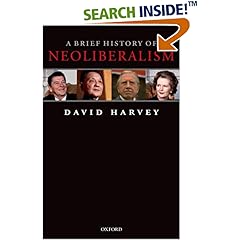
I got tired of blogging for a while. But I'm back. In the next few days I'll be "reviewing"/summarizing David Harvey's A Brief History of Neoliberalism. Here's something to get you started:
David Harvey's A Brief History of Neoliberalism makes for compelling reading for those interested in the political economy of the last thirty-odd years. Or should I say thirty odd years.
Of particular interest is not only the historical sweep of the book, or its relative clarity compared to other works by Harvey, but the prism the author gives the reader to understand the present contradictions of globalism comprehensively, from economic, political and, yes, even moral points of view.
The book's foundation stands on Harvey's ability to weave the global aspects of international capital into case studies of countries who have tried neoliberalism (voluntarily or not) to varying degrees, from Britain to Chile, Argentina, Mexico, China and, of course, the U.S. From his analyses, Harvey steps naturally and logically out of history and into an investigation of the current state of neoliberalism and its possible futures. As Harvey points out, citing visionary thinking of Polanyi, neoliberalism, in both philosophy and practice, is fraught with contradictions and ambiguities that lend it strength while undermining its central tenets. In a word, there is much to be afraid of, but there is also space for hope.
Freedom
Understanding neoliberalism requires an introduction to the basic tenets of 'freedom' as laid out by the Mont Pélerin Society shortly after World War II. Led by political philosopher Friederich van Hayek, the society set out to combat what they saw as the primary “dangers” facing the Occident:
The central values of civilization are in danger...even that most precious possession of Western Man, freedom of thought and expression, is threatened by the spread of creeds, which...seek only to establish a position of power in which they can suppress and obliterate all views but their own.
The group holds that these developments have been fostered by the growth of a view of history which denies all absolute moral standards and by the growth of theories which question the desirability of the rule of law. It holds further that they have been fostered by a decline of belief in private property and the competitive market; for with the diffused power and initiative associated with these institutions it is difficult to imagine a society in which freedom may be preserved. (Harvey 20)
Hence, as Harvey points out, freedom bcomes the result of private property and a competitive market. Relying on neoclassical economics and the rational actor, neoliberalism showed a great distrust of certain types of government intervention such as centralized control of the economy as predicated in the Keynsian tradition coming out of the Great Depression and especially in the dirigiste form found in countries like France and Mexico. The founding Neoliberals believed that no government had enough access to economic information to accurately plan an economy and that only the invisible hand of the market could make such decisions.
“The scientific rigor of its neoclassical economics does not,” writes Harvey, “sit well with its political ideas of freedom, nor does its supposed distrust of state power for a strong and if necessary coercive state that will defend the rights of private property, individual liberty and entrepreneurial freedoms” (21). Indeed, the contradictions between personal and entrepreneurial freedom become rapidly apparent as one neoliberal state after another paradoxically increases state power over the individual to ensure freedoms for that other individual, the corporate enterprise. This seems to prove the thinker Polayni uncannily prescient:
Planning and control are being attacked as a denial of freedom. Free enterprise and private ownership are declared to be essentials of freedom. No society built on other foundations is said to deserve to be called free. The freedom that regulation creates is denounced as unfreedom; the justice liberty and welfare it offers are described as a camouflage of slavery. (Harvey 37)
Besides these obvious contradictions, neoliberalism is also blind to power within the system. (Perhaps this is intentional.) Because no market is free from the influence of power, there is a tendency in them to move towards monopolistic or oligopolistic forms of enterprise. While there are some exceptions, this has proven true in almost every mature market, whether it is a question of car manufacturers or, in particular and most dangerously, mass media. Mirroring the establishment of giant enterprises is the revival of a self-reinforcing and growing elite using wealth to increase power and vice versa. The result, as Harvey notes, means that the top 358 fortunes of 1996 equaled the combined wealth of the bottom 2.3 billion, that is, the bottom 45% of the world's population (34-35). In other words, neoliberalism has meant a revival of class power, and this too has implications for freedom, since the voices of many poor and middle-class citizens remain unheard or weakened under the strains of the supposedly democratic neoliberal state.
End of part I. More to follow tomorrow.
Saturday, December 16, 2006
I'll be gone
for a few days. That means something really interesting is going to
happen and I won't have access to the internet--not even The Google.
happen and I won't have access to the internet--not even The Google.
Yes, "The Google":
http://thinkprogress.org/2006/10/23/bush-says-he-uses-the-google/
Friday, December 15, 2006

Wednesday, December 13, 2006
Why I like Paul Krugman
Paul, I like you because you say it all so well and because you say
things a lot of rich people don't want you to say. Keep making the
aristocrats mad, you have my vote.
things a lot of rich people don't want you to say. Keep making the
aristocrats mad, you have my vote.
"Rising inequality isn't new. The gap between rich and poor started growing before Ronald Reagan took office, and it continued to widen through the Clinton years. But what is happening under Bush is something entirely unprecedented: For the first time in our history, so much growth is being siphoned off to a small, wealthy minority that most Americans are failing to gain ground even during a time of economic growth -- and they know it.
A merica has never been an egalitarian society, but during the New Deal and the Second World War, government policies and organized labor combined to create a broad and solid middle class. The economic historians Claudia Goldin and Robert Margo call what happened between 1933 and 1945 the Great Compression: The rich got dramatically poorer while workers got considerably richer. Americans found themselves sharing broadly similar lifestyles in a way not seen since before the Civil War.
But in the 1970s, inequality began increasing again -- slowly at first, then more and more rapidly. You can see how much things have changed by comparing the state of affairs at America's largest employer, then and now. In 1969, General Motors was the country's largest corporation aside from AT&T, which enjoyed a government-guaranteed monopoly on phone service. GM paid its chief executive, James M. Roche, a salary of $795,000 -- the equivalent of $4.2 million today, adjusting for inflation. At the time, that was considered very high. But nobody denied that ordinary GM workers were paid pretty well. The average paycheck for production workers in the auto industry was almost $8,000 -- more than $45,000 today. GM workers, who also received excellent health and retirement benefits, were considered solidly in the middle class.
Today, Wal-Mart is America's largest corporation, with 1.3 million employees. H. Lee Scott, its chairman, is paid almost $23 million -- more than five times Roche's inflation-adjusted salary. Yet Scott's compensation excites relatively little comment, since it's not exceptional for the CEO of a large corporation these days. The wages paid to Wal-Mart's workers, on the other hand, do attract attention, because they are low even by current standards. On average, Wal-Mart's non-supervisory employees are paid $18,000 a year, far less than half what GM workers were paid thirty-five years ago, adjusted for inflation. And Wal-Mart is notorious both for how few of its workers receive health benefits and for the stinginess of those scarce benefits.
The broader picture is equally dismal. According to the federal Bureau of Labor Statistics, the hourly wage of the average American non-supervisory worker is actually lower, adjusted for inflation, than it was in 1970. Meanwhile, CEO pay has soared -- from less than thirty times the average wage to almost 300 times the typical worker's pay.
The widening gulf between workers and executives is part of a stunning increase in inequality throughout the U.S. economy during the past thirty years. To get a sense of just how dramatic that shift has been, imagine a line of 1,000 people who represent the entire population of America. They are standing in ascending order of income, with the poorest person on the left and the richest person on the right. And their height is proportional to their income -- the richer they are, the taller they are.
Start with 1973. If you assume that a height of six feet represents the average income in that year, the person on the far left side of the line -- representing those Americans living in extreme poverty -- is only sixteen inches tall. By the time you get to the guy at the extreme right, he towers over the line at more than 113 feet. http://www.rollingstone.com/politics/story/12699486/paul_krugman_on_the_great_wealth_transfer/print
Another Indictment of our (in)justice system
Today at Tompaine.com:
“First, the Supreme Court denied the appeal of Weldon Angelos for a first-time drug offense. Angelos was a 24-year-old Utah music producer with no prior convictions when he was convicted of three sales of marijuana in 2004. During these sales he possessed a gun, though there were no allegations that he ever used or threatened to use it. Under federal mandatory sentencing laws, the judge was required to sentence Angelos to five years on the first offense and 25 years each for the two subsequent offenses, for a total of 55 years in prison. In imposing sentence, Judge Paul Cassell, a leading conservative jurist, decried the sentencing policy as “unjust, cruel, and even irrational.”
The Angelos decision came on the heels of a Bureau of Justice Statistics report finding that there are now a record 2.2 million Americans incarcerated in the nation’s prisons and jails. These figures represent the continuation of a “race to incarcerate” that has been raging since 1972. With a 500 percent increase in the number of people in prison since then, the United States has now become the world leader in its rate of incarceration, locking up its citizens at 5-8 times the rate of other industrialized nations. The strict punishment meted out in the Angelos case and thousands of others explain much of the rapid increase in the prison population.
The composition of the prison population reflects the socioeconomic inequalities in society. Sixty percent of the prison population is African American and Latino, and if current trends continue, one of every three black males and one of every six Latino males born today can expect to go to prison at some point in his lifetime. The overall rates for women are lower, but the racial and ethnic disparities are similar and the growth rate of women’s incarceration is nearly double that of men over the past two decades.” ( http://www.tompaine.com/articles/2006/12/11/incarceration_nation.php)
“First, the Supreme Court denied the appeal of Weldon Angelos for a first-time drug offense. Angelos was a 24-year-old Utah music producer with no prior convictions when he was convicted of three sales of marijuana in 2004. During these sales he possessed a gun, though there were no allegations that he ever used or threatened to use it. Under federal mandatory sentencing laws, the judge was required to sentence Angelos to five years on the first offense and 25 years each for the two subsequent offenses, for a total of 55 years in prison. In imposing sentence, Judge Paul Cassell, a leading conservative jurist, decried the sentencing policy as “unjust, cruel, and even irrational.”
The Angelos decision came on the heels of a Bureau of Justice Statistics report finding that there are now a record 2.2 million Americans incarcerated in the nation’s prisons and jails. These figures represent the continuation of a “race to incarcerate” that has been raging since 1972. With a 500 percent increase in the number of people in prison since then, the United States has now become the world leader in its rate of incarceration, locking up its citizens at 5-8 times the rate of other industrialized nations. The strict punishment meted out in the Angelos case and thousands of others explain much of the rapid increase in the prison population.
The composition of the prison population reflects the socioeconomic inequalities in society. Sixty percent of the prison population is African American and Latino, and if current trends continue, one of every three black males and one of every six Latino males born today can expect to go to prison at some point in his lifetime. The overall rates for women are lower, but the racial and ethnic disparities are similar and the growth rate of women’s incarceration is nearly double that of men over the past two decades.” ( http://www.tompaine.com/articles/2006/12/11/incarceration_nation.php)
Tuesday, December 12, 2006
Crime and Punishment (of the innocent)
With all the outsourcing to China, I'm glad to see we're forging ahead in the prison-industrial complex. I mean, if we can't do "shake 'n' bake" democracy in the Middle East, at least we know how to incarcerate people:
According to the International Center for Prison Studies at King's College in London, the US has 700,000 more of its citizens incarcerated than China, a country with a population four to five times larger than that of the US, and 1,330,000 more people in prison than crime-ridden Russia. The US has 5% of the world's population and 25% of the world's prisoners. The American incarceration rate is seven times higher than that of European countries. Either America is the land of criminals, or something is seriously wrong with the criminal justice (sic) system in "the land of the free."
In the US the wrongful conviction rate is extremely high. One reason is that hardly any of the convicted have had a jury trial. No peers have heard the evidence against them and found them guilty. In the US criminal justice (sic) system, more than 95% of all felony cases are settled with a plea bargain. (Counterpunch)
Ah, ain't freedom grand? Ok, sorry to be snarky. This is tragic.
It's not a conspiracy...
I don't really believe much in conspiracies. Sure, they exist. But most things like, say, the killing of Allende by Pinochet supporters with strong help from the CIA, or the promotion of Curveball within the U.S. "intelligence" network, are actually done in the open. To call them conspiracies would be to deflect attention from the very real power of social networks and the (in)human actions that take place thanks to hierarchical and peer systems.
That's why I found the following a fun read. Corporations, especially in the last 50 years, have gone viral. The belief system they promote (to the disadvantage of many struggling humans) has spread far and wide, infiltrating the deepest core of our beings.
That's why I found the following a fun read. Corporations, especially in the last 50 years, have gone viral. The belief system they promote (to the disadvantage of many struggling humans) has spread far and wide, infiltrating the deepest core of our beings.
Is the consumerist totalization of this country and the world really a conscious plot by a handful of powerful corporate and financial masters? If we answer "yes" we find ourselves trundled off toward the babbling ranks of the paranoid. Still though, it's easy enough to name those who would piss themselves with joy over the prospect of a One World corporate state, with billions of people begging to work for their 1,500 calories a day and an xBox chip in their necks. It's too bad our news media quit hunting with live ammo decades ago, leaving us with no one to track the activities and progress of what sure as hell seem to be global elites, judging from the financial spoor we find along every pathway of modern life.In our saner moments we can also see that it does not take dark super-centralized plotting to pull off what appears to have been accomplished. Even without working in overt concert, a few thousands of dedicated individual corporate and financial interests can constitute a unified pathogenic whole, much the same as individual cells create a viable dominant colony of malignant organisms -- malignant simply by their anti-human, anti-societal nature. We don't see GM, Halliburton, Burger King and CitiBank lobbying the state for universal health or clean rivers, do we? But mention unions or living wages, and the financial colony within our national Petri dish shape shifts into a Gila monster and squirts venom on the idea and shits money all over Capitol Hill. I looked at all this as coincidence for years until the proposition finally strained credulity so much that I threw in the towel and said, "Fuck it. There is only so much coincidence to go around in this world. [Source: http://www.joebageant.com/joe/2006/12/somewhere_a_ban.html h/t: http://www.electricedge.com/greymatter/archives/00007254.htm]
Friday, December 08, 2006

Wednesday, December 06, 2006
NSTA: Teachers Owned by Corporations
Ah, thanks, National Science Teachers Association. I just got an email back from you about your refusal to distribute--for free--"An Inconvenient Truth." Here's what you said:
I am not surprise by your letter however, given your board of corporate advisors:
Whores!
I'm also VERY impressed that NSTA has people from Clear Channel on its board. They produce so much serious scientific programming and are so well known for providing their clients with a docile and demographically defined audience to advertise to through their numerous outlets. They are also known for their liberal attitude toward freedom of thought and speech, those hallmarks of progress.
I'm disappointed that, in your letter, you are neither honest about one of the obvious reasons you refused Laurie David (you're afraid of losing your corporate sponsorship) nor do you admit that this is a loss for students who would have been better educated and better served by that documentary than by those produced by Exxon that are available for free to teachers.
Thanks. Thanks for nothing.
Dear Colleague:It's really nice of you to write back, but you still don't explain why it would be an "endorsement" if you simply took the donation of the films. It doesn't explain how that "endorsement" would differ from your two full pages of corporate sponsors (pages 22-23 of your 2003 annual report). It doesn't explain why you take money from Exxon and Chevron, but you refuse a free donation from Laurie David. It doesn't explain how a physical or intellectual gift that you redistribute to your members is any different from monetary gifts you receive and redistribute to your members in the form of services for their membership.
Thank you for your recent e-mail expressing your opinion about the National Science Teacher Association’s decision in regard to the DVD “An Inconvenient Truth.” We value each and every comment we have received from our members and friends.
First and foremost, we want to ensure that you have the most current and accurate information about the issue. Ms. Laurie David, producer of AIT, asked NSTA to distribute 50,000 copies of the movie to its members. The NSTA Board of Directors stood by its 2001 NSTA policy prohibiting endorsements and decided not to mass distribute the DVD to members without their consent or request because it would constitute an endorsement.
As you will see in the letter that NSTA sent to Ms. David on Thursday, November 30, 2006 (http://www.nsta.org/main/pdfs/20061130LetterToLaurieDavid.pdf) we provided her with several options to publicize the availability of the DVD to both our members and the wider universe of science educators worldwide via our communication channels. We also invited Mr. Gore to participate at the NSTA National Conference in March.
This information and more is available on our website at www.nsta.org. We encourage you to read these documents.
Sincerely,
Linda Froschauer
President 2006-2007
National Science Teachers Association
Gerald Wheeler
Executive Director
National Science Teachers Association
I am not surprise by your letter however, given your board of corporate advisors:
Richard SchaarI have no doubt that Toyota and Exxon were thrilled to hear about Gore's movie, so it must have been your other friends that threw down the gauntlet. Let me just say that this makes you look bad. In fact, I'm tempted to call you whores.
Texas Instruments
Edwar Ahnert
Exxon Mobil Foundation
John Anderson
Toshiba America
Alfred R. Berkeley III
NASDAQ
George Borst
Toyota Financial Services
Mark Emmert
Louisiana State University
Stacy King
Clear Channel
Len Roberts
RadioShack Corp.
Whores!
I'm also VERY impressed that NSTA has people from Clear Channel on its board. They produce so much serious scientific programming and are so well known for providing their clients with a docile and demographically defined audience to advertise to through their numerous outlets. They are also known for their liberal attitude toward freedom of thought and speech, those hallmarks of progress.
I'm disappointed that, in your letter, you are neither honest about one of the obvious reasons you refused Laurie David (you're afraid of losing your corporate sponsorship) nor do you admit that this is a loss for students who would have been better educated and better served by that documentary than by those produced by Exxon that are available for free to teachers.
Thanks. Thanks for nothing.
It was five years ago today
That John Ashcroft said in front of the Senate: "To those who scare peace-loving people with phantoms of lost liberty, my message is this: Your tactics only aid terrorists for they erode our national unity and diminish our resolve. They give ammunition to America's enemies and pause to America's friends." (Dec. 6 2001)
Translation: "Those of you who complain of losing your civil liberties are in bed with the enemy."
That the man is not in jail shows how little we have progressed since then, but there are signs of hope and resistance to unconstitutionally enforced subordination.
We had an election and won. We won not based on fear but rather on the knowledge that the erosion of constitutional protections, begun under Ashcroft and embraced wholeheartedly by Gonzalez, was and is doing significant harm to the United States as a nation and as a set of individuals seeking prosperity and community within its borders. We won using community, netroots, personal phone calls, alternative media. We won thanks to people and unions. We won in spite of corporate media's tepid, untruthful and polluting "journalism." We won in spite of millionaire pundits. We won on the self-evident observations of what we see around us in factories, offices, cafes, restaurants, and family dinners. We won thanks to the pictures we saw--and not the interpretations of them by the priesthood.
Yet, in spite of this, we see our own citizens tortured and handcuffed. We see our physical environment degraded through exploitation. We see our community and mental environment degraded by surveillance; we are watched rather than protected. We see a new boss in the Pentagon, same as the old boss, and we see senators welcome him like a pal. We see the gods of Wall Street lecture the democrats on how they are supposed to act. We see trade deficits and deficits of discourse and action.
In sum...
All is still not well in the corporate kingdom of brand America.
Translation: "Those of you who complain of losing your civil liberties are in bed with the enemy."
That the man is not in jail shows how little we have progressed since then, but there are signs of hope and resistance to unconstitutionally enforced subordination.
We had an election and won. We won not based on fear but rather on the knowledge that the erosion of constitutional protections, begun under Ashcroft and embraced wholeheartedly by Gonzalez, was and is doing significant harm to the United States as a nation and as a set of individuals seeking prosperity and community within its borders. We won using community, netroots, personal phone calls, alternative media. We won thanks to people and unions. We won in spite of corporate media's tepid, untruthful and polluting "journalism." We won in spite of millionaire pundits. We won on the self-evident observations of what we see around us in factories, offices, cafes, restaurants, and family dinners. We won thanks to the pictures we saw--and not the interpretations of them by the priesthood.
Yet, in spite of this, we see our own citizens tortured and handcuffed. We see our physical environment degraded through exploitation. We see our community and mental environment degraded by surveillance; we are watched rather than protected. We see a new boss in the Pentagon, same as the old boss, and we see senators welcome him like a pal. We see the gods of Wall Street lecture the democrats on how they are supposed to act. We see trade deficits and deficits of discourse and action.
In sum...
All is still not well in the corporate kingdom of brand America.
Livestock are really bad for the environment
According to a United Nations report, livestock are large contributors to greenhouse gases:
Manger de la viande nuit à l'environnement. C'est la conclusion à laquelle parvient l'Organisation des Nations unies pour l'alimentation et l'agriculture (FAO) qui a rendu public, mercredi 29 novembre, un rapport consacré à l'impact écologique de l'élevage. Celui-ci est "un des premiers responsables des problèmes d'environnement", affirme un des auteurs, Henning Steinfeld.No big surprise here, but I hope this pushes a few more people to reduce their protien intake. Eventually we will face some dire consequences if nobody starts talking about this.
Mesurée en équivalent CO2, la contribution de l'élevage au réchauffement climatique est plus élevée que celle du secteur des transports.[Eating meat harms the environment. That's the conclusion of the Food and Agriculture organization of the United Nations, which published on Wednesday, November 29th, a report dedicated to the ecological impact of livestock. The latter is "one of the primary factors of environmental problems," according to the authors Henning and Steinfeld.]
Measured in equivalent CO2, the contribution of raising livestock to climate warming is greater than in the transport sector.
(Loose translation from Le Monde)
Monday, December 04, 2006
Friedman: Liar, war-monger... respected.
Friedman takes a lot of flack... and it is all deserved. That he is one of the leading opinion-makers is both travesty and tragedy.
I should have linked to Greenwald earlier:
I should have linked to Greenwald earlier:
But tragically, there is nothing unique about Tom Friedman. What drives him is the same mentality that enabled the administration's invasion of Iraq and, so much worse, it is the mentality that is keeping us there and will keep us there for the indefinite future. We stay in Iraq in pursuit of goals we know are fantasies, because to do otherwise requires the geniuses and serious establishment analysts to accept responsibility for what they have done -- and that is, by far, the most feared and despised outcome.
Subscribe to:
Posts (Atom)


